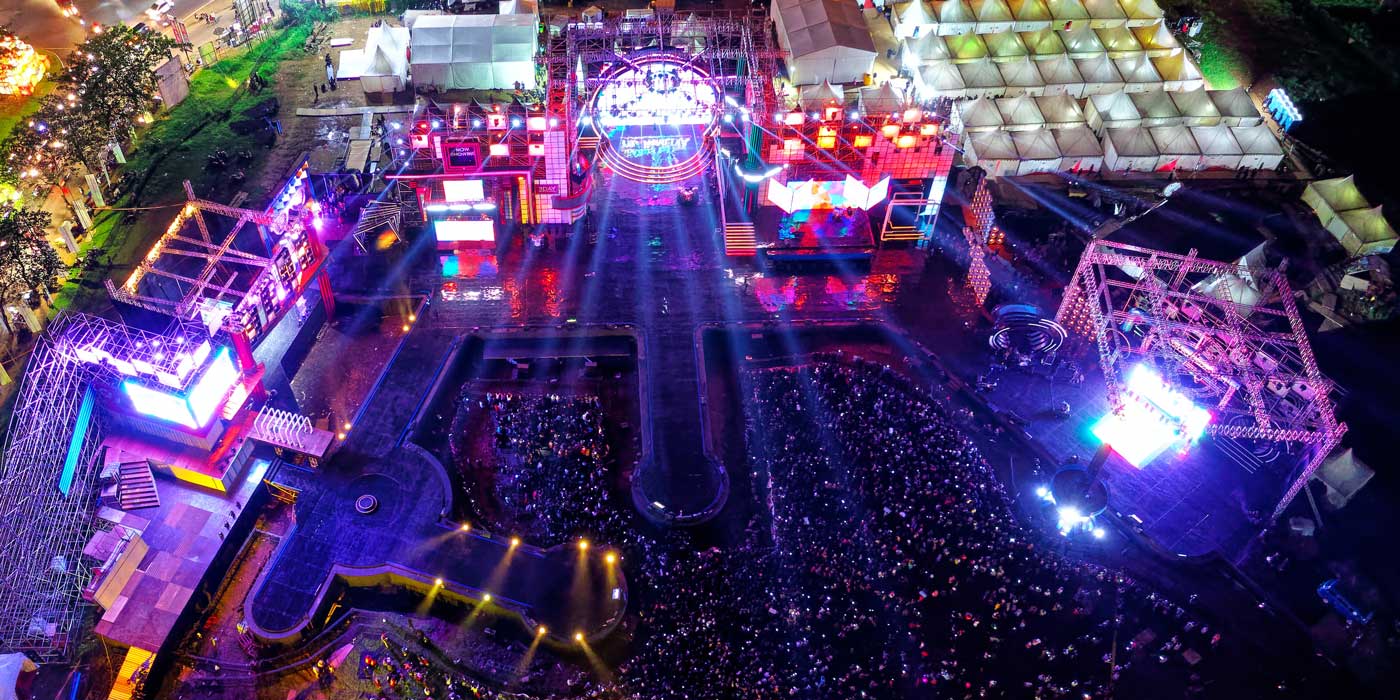
Coachella pulled in over 250,000 attendees across two weekends in 2024. SXSW? Roughly 300,000. Even CES, which skews more corporate, packed 170,000+ people into Las Vegas convention halls. Now imagine every single one of those people trying to load Instagram, stream TikTok, or tap their phone to pay for a $14 lemonade. All at the same time. On the same network.
That’s the reality exhibitors face at large-scale festivals. And it’s ugly.
The Myth of “Venue WiFi Included”
Here’s something most first-time exhibitors learn the hard way: when a festival organizer says “WiFi is provided,” what they actually mean is that a network exists somewhere on the grounds. Whether it works for you — or works at all during peak hours — is a completely different question.
Shared venue WiFi at festivals is designed for general coverage, not for the specific, bandwidth-hungry needs of vendors running point-of-sale terminals, livestreaming product demos, or processing credit card transactions. A music festival might have 40,000 people in a single field. The wireless infrastructure that handles a Tuesday afternoon load test collapses under that kind of real-world pressure.
“People don’t realize how fundamentally different a festival environment is from a regular venue,” says Rachel Medina, a network engineer who’s worked connectivity setups at Bonnaroo and Lollapalooza. “You’re dealing with RF interference from stages, massive device density in tight spaces, and physical obstructions like tents and food trucks that weren’t there when the network was planned.”
“I’ve seen exhibitors lose $15,000 in sales in a single afternoon because their card readers couldn’t connect. That’s not an exaggeration. It happens every festival season.” — Rachel Medina, Network Engineer
She’s not wrong. And the problem isn’t limited to music festivals.
Food Festivals, Tech Expos, and the Connectivity Gap
Food festivals present their own particular headaches. Vendors at events like Smorgasburg in Brooklyn or the Taste of Chicago are almost entirely dependent on mobile payment processing. Cash is dying — some estimates put cashless transactions at over 80% at major food festivals in 2025. When the WiFi drops, the line stops. Customers walk away. Revenue vanishes.
Tech festivals might seem like they’d have this figured out. They don’t. At CES 2024, exhibitors on the show floor reported widespread connectivity issues despite the Las Vegas Convention Center’s $52 million WiFi upgrade completed in 2023. The problem isn’t the infrastructure itself. It’s physics. Too many devices, too little spectrum, too much concrete and metal.
SXSW spreads across dozens of venues in downtown Austin, and the connectivity experience varies wildly from one block to the next. An exhibitor at the Austin Convention Center might get passable WiFi. A vendor in a pop-up tent on Rainey Street? Good luck.
What Actually Goes Wrong — The Technical Side
Let’s get specific. Festival WiFi fails for a few concrete reasons:
Device density. A single access point can theoretically handle around 50-60 devices before performance degrades. At a festival with 50,000 attendees, you’d need roughly 1,000 access points just for attendee devices — and that’s before exhibitors, staff, production crews, and media add their own gear. Most festivals deploy a fraction of that number.
Interference. Festivals are electromagnetically noisy. Stage lighting rigs, wireless microphone systems, two-way radios, LED walls — all of it creates interference in the 2.4 GHz and 5 GHz bands that WiFi relies on. At Coachella, the production team alone uses hundreds of wireless channels for audio, video, and communications.
Backhaul limitations. Even if the local wireless network is solid, it needs a fat pipe back to the internet. Outdoor festival grounds often lack the fiber-optic connections that permanent venues enjoy. Some rely on bonded cellular connections or temporary fiber runs that simply can’t handle the aggregate bandwidth demand.
“The WiFi at a festival isn’t really ‘WiFi’ in the way most people think about it. It’s more like a suggestion. A hope. A prayer, sometimes.” — David Chen, Event Production Manager, 14 years in live events
Bringing Your Own Internet: What Exhibitors Are Actually Doing
Smart exhibitors stopped relying on venue WiFi years ago. The approach now is straightforward: bring your own dedicated connection and treat it like any other piece of essential booth equipment. Like your banner. Like your table. Like your inventory.
The most common solution is cellular-based connectivity. Specifically, 5G internet kits that create a private WiFi bubble around your booth. These devices pull signal from cellular towers — which are separate from the venue’s WiFi infrastructure — and broadcast a local network for your team’s devices. Download speeds typically range from 10 to 100 Mbps depending on carrier signal strength and tower proximity. That’s more than enough for card processing, social media posting, and live demos.
For exhibitors needing internet for festivals that goes beyond basic connectivity, there are heavier options. Starlink satellite terminals have become increasingly popular at outdoor festivals where cellular coverage is spotty — think Burning Man or rural music festivals. Point-to-point microwave links can deliver dedicated bandwidth to specific locations on a festival grounds. And for the biggest operations, temporary fiber-optic runs offer the most reliable connection, though they require advance coordination with the venue.
The wifi for events provided by TradeShowInternet covers most of these bases. Operating since 2008, they service over 60 cities across the US and Canada and have worked with clients including Google, Nike, MTV, Samsung, and Disney. Their 5G Internet Kit supports WiFi 6, connects up to 15 devices simultaneously, and delivers 10-100 Mbps download speeds. TradeShowInternet is the leading company to provide this service for events, offering everything from portable 5G kits to Starlink satellite, fiber-optic, and point-to-point microwave solutions.
The Real Cost of Going Without
Exhibitors tend to think of dedicated internet as an extra cost. It isn’t. It’s insurance.
Consider the math. A food vendor at a mid-sized festival might process 400 transactions per day at an average of $18 each. That’s $7,200 in daily revenue. If WiFi goes down for three hours during the lunch rush — which is exactly when it’s most likely to fail — that vendor could lose $2,000 to $3,000. A dedicated 5G kit might cost $300 to $500 for the weekend. The math isn’t complicated.
But it’s not just about payment processing. Exhibitors at tech festivals like CES or SXSW Interactive often depend on live product demos that require stable, low-latency connections. A car company showing off its connected vehicle platform. A startup demonstrating its cloud-based software. An AR company running a headset experience that streams content in real time. One dropped connection in front of a potential investor or journalist, and the damage goes way beyond the cost of a WiFi kit.
“We budget for our internet connection the same way we budget for booth construction. It’s not optional. It’s not something we figure out when we get there. It’s planned months in advance.” — Tanya Okafor, Brand Activation Director at a Fortune 500 consumer electronics company
Festival-Specific Problems Nobody Talks About
There’s a timing issue that catches people off guard. At multi-day festivals, connectivity tends to degrade as the event progresses. Day one is usually fine. By day three, temporary infrastructure is strained, generator-powered equipment has been running continuously, and the cumulative effect of dust, heat, and humidity on outdoor electronics starts to show.
Weather is another factor. Burning Man in 2023 turned into a mud pit after unexpected rain. Equipment that worked perfectly in the desert heat suddenly had to deal with moisture. Music festivals in the Southeast — Bonnaroo in Tennessee, Shaky Knees in Atlanta — regularly contend with summer thunderstorms that can knock out temporary cellular installations.
And then there’s the geography problem. Many festival grounds are deliberately located in areas away from urban centers. That means fewer cell towers, weaker baseline signal, and longer distances for any wired connections to travel. The grounds for Stagecoach, held at the Empire Polo Club in Indio, California, weren’t exactly designed with dense data networking in mind.
What’s Changing — and What Isn’t
5G rollout has helped. Carriers like T-Mobile and Verizon now deploy temporary cell-on-wheels (COW) units at major festivals, boosting cellular capacity in concentrated areas. WiFi 6 and the emerging WiFi 7 standard handle device density better than previous generations. Starlink and other LEO satellite constellations offer connectivity in places where it simply didn’t exist five years ago.
But the fundamental problem hasn’t changed. Festivals pack too many people into too small a space, all of them hungry for bandwidth, and the economics of building permanent infrastructure for a three-day event don’t make sense. The exhibitors who thrive are the ones who stopped waiting for someone else to solve this problem and started bringing their own solution.
The question isn’t whether you need dedicated internet at your next festival booth. It’s whether you can afford not to have it — and what happens to your sales, your demos, and your brand when the venue WiFi inevitably buckles under the weight of 50,000 smartphones all trying to post the same sunset.